易
Welcome to n Lines & Changing, an ongoing project that grows and changes as material gathered over the past dozen (and counting) years of living in Shanghai finds and loses form in poetic lines, photos, sound collages, documentation and critical reflection.
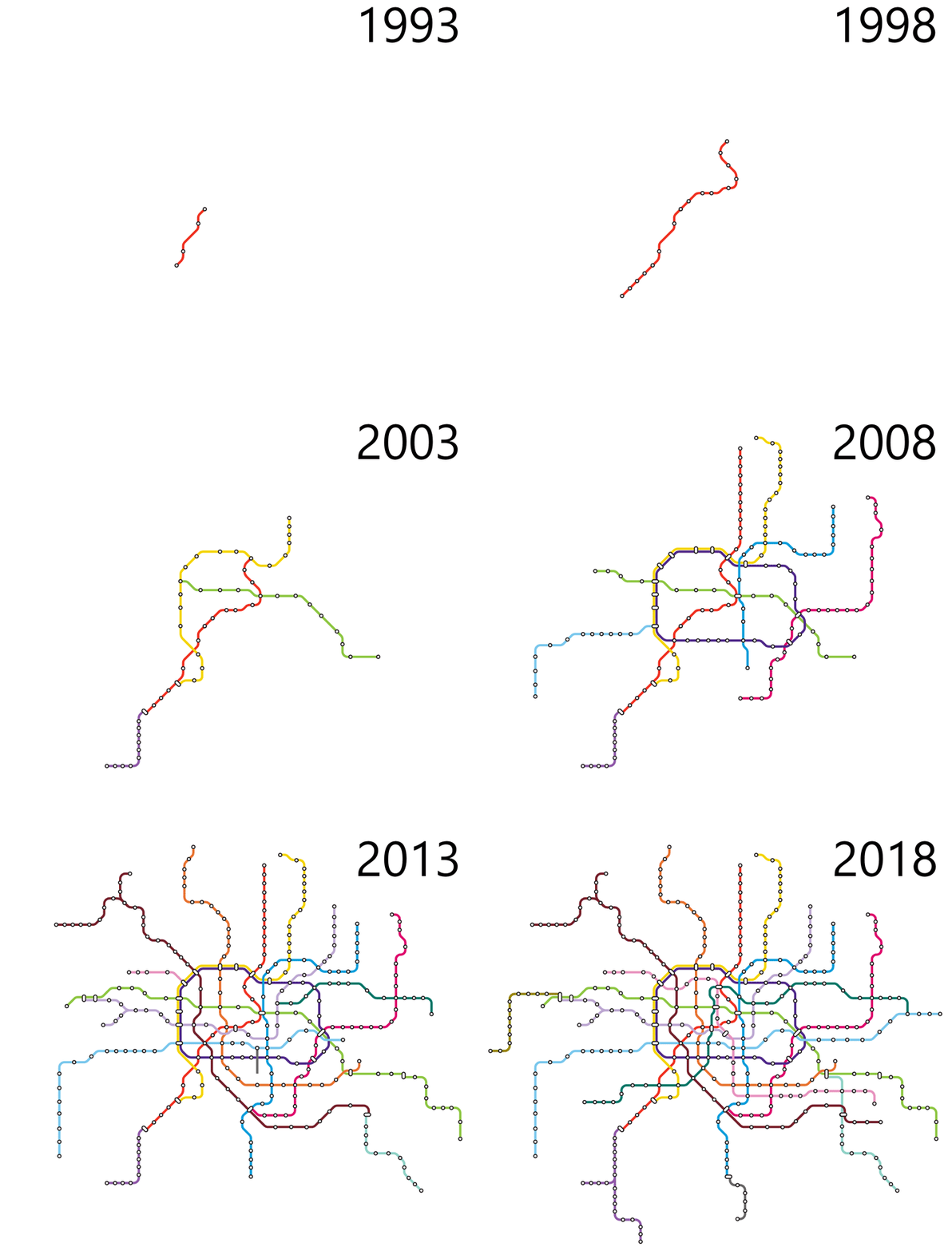
New lines join the System Poem as new Station Poems register on the Map, accompanied by photos and blog posts as well as video and audio content — all drawing from a dozen-plus years of doing algorithmic walks in the vicinity of randomly assigned Shanghai Metro stops.
The project in two lines
- Ride the Shanghai Metro system to the end
- Write the Shanghai Metro system to the end
The method
n Lines & Changing draws upon practices and projects of preceding experimentalists termed, variously and to various degrees of seriousness, psychogeographers, flippists, randonauts, Surrealists, Situationists, Oulipians, and students of the Changes 易 — the I-Ching, Yijing, Book of Changes or Classic of Changes (with the darker Zhouyi/Changes of Zhou seething beneath the surface of the domesticated Confucian revisions and commentary).
The Changes 易 (various versions and translations, consulted in various ways and with attention to textual and cultural histories) provide both text and context for thinking about a given walk and resulting lines of poetry while also providing a walking algorithm: solid yang lines mean “turn right” and broken yin lines mean “turn left.”
An unchanging hexagram provides a six-step series of lefts and rights; a changing hexagram yields a series of twelve turns. Often, an hour or so of walking and repeating the algorithm brings the walker to the back to the starting point. The walks in turn provide the raw material for the lines and accompanying documentation.
The point
The point is manifold.
It radiates lines: a way to do poetry.
It’s the walks: a way to inhabit and explore Shanghai.
It’s an engagement with intentional and methodical use of randomness to arrive at arrangements and awarenesses of present flux, past lines of origin, and possible future lines of flight.
It’s “divination” in the sense of seeking and describing brief moments of passage through time, of limning assemblages of material & energy flows in dynamic spatial arrangements — and then seeking to make something out of what those moments may give rise to (or obliterate).
It’s also, certainly, a way of self-education and research into “China” and the world in which “China” has been a primary driver and shaper of the “World,” very much including “the West.” This means, among other things: When one (in particular, an “expat”) presumes to think and write of “Shanghai,” where & when is one coming from? Where & when is one in the moment of address, or of being addressed? And where & when might one be going?
It is also very much an embrace of process and the impossibility of completeness or conclusion, and as such, looks to aesthetic, literary and philosophical traditions as well as contemporary conversations of many kinds to deepen and extend the play and work of figuring itself out.
More along similar lines follows.
Some background
Conceived originally as an anti-travel guide designed to generate irreproducible excursions and experiences by use of an easily reproducible method, it has become an ongoing engagement and experiment that, on one hand, is rooted in the age-old human modes (those of walking and of writing and of the kinds of pattern-recognition and making that include divinatory practices of many kinds, the 易 very much included) and that, on the other hand, seeks to extend, crystallize, and dissipate into the digital, algorithmically overdetermined froth of our contemporary moment.
The mode
The primary mode has been that of poetry, and specifically the long poem, supplemented along the way by photography, sound recording, and blog posts on subjects including poetry and poetics, translation, the complex history of the 易 Changes both in Sinophone culture as well Western culture, and various lines of research and speculation that have arisen in the course of things — n Lines has evolved into an expanding, messy research project, one that draws deeply on our planetary and collective human past generated within the translational focal zone where the proverbial “East” of China and its civilizational sphere meet the “West” articulated largely within the past 500-some years of European mercantile and colonial expansion (and retraction and collapse into various neo– and post– conceptualizations).
& more, from the planetary to the personal
Additionally, the work has increasingly involved engagement with the seething welter of possible post-Holocene (or, if you prefer, Anthropocene) futures rooted both in our present moment of accelerating technological change and in a fascination with the deep time of evolution, human pre-history, geological time, Earth systems science, and the dynamics of cultural and linguistic change.
Finally, n Lines is a record of my time in Shanghai. This is a time in which my life has changed a great deal — my partner and I married, and our daughter was born and raised in the city. The personal inevitably interlaces with my attempts to make something of the city and its history into a long poem that approaches — and perhaps, at points, briefly attains — adequacy.
If it all sounds like too much, it certainly is, and that is both the point and, or, if you like, the pointlessness of it.
Moving forward, n Lines & Changing will feature new Station poems created from materials gathered over past years of conducting algorithmic walks in Shanghai as well as new walks conducted when I’m in the city. It will feature critical reflections on the poems, process, and questions of if and how this work — as well as poetry and other modes of composition and critique — might contribute in useful and meaningful, if inevitably marginal and minor, ways to conversations arising from a time in which humankind and the innumerable species with which we have co-evolved are experiencing accelerating rates of change in all areas of life, and to degrees that threaten to radically alter or even end much or all of life as we know it.
There’s always more, but there’s always, too, the need to stop in order to reorient & start again, and so: 易